by Dorothee Schröder
Walbrook is a short street in the City of London, running between Queen Victoria Street in the north and Cannon Street in the south. It lies within the ward of Walbrook, which takes its name from one of London’s lost rivers. In fact, the street follows the lower course of this former brook.
The Walbrook once flowed from the area of present-day Shoreditch southwards to Cannon Street, where it entered the Thames, passing beneath what is now the site of the Bank of England. As rivers were considered sacred by the Romans, religious buildings were erected along its banks. One of the most significant was the Temple of Mithras, built around AD 240.
During the Middle Ages, the Walbrook became an important centre of industry and trade. Mills, workshops, tanneries, leatherworks and livery halls lined its banks, making use of the constant water supply.
From the 15th century onwards, the river was gradually diverted underground. In 1440, the Church of St Mary Lothbury was built over its upper course. Over time, as the river became increasingly polluted with rubbish and sewage and emitted a terrible stench, the decision was made to enclose it completely.
Today, the Walbrook shares the fate of many of London’s lost rivers and survives only as part of the sewer system. Yet the waterlogged ground along its former course proved ideal for preserving objects from the past. When excavations took place centuries later, many finds were discovered in remarkably good condition. The rediscovery of the Temple of Mithras in 1954 is one of the most striking examples, and the reconstructed temple can still be visited today.
Even now, the street of Walbrook reveals traces of the old river valley, most noticeably at the junction with Cannon Street. The church of St Stephen Walbrook stands on what was once the eastern bank of the river. Originally located on the western side, it was rebuilt around 1439 on the opposite bank. After its destruction in the Great Fire of London in 1666, Sir Christopher Wren designed the church that still stands there today, completed in 1672.
The ward of Walbrook remains one of the most significant areas in the City of London. It is home to the Bank of England and the Mansion House, the official residence of the Lord Mayor of London. Nearby on Cannon Street, the historic London Stone is also on display.
Thus, not only the street itself but the entire area of Walbrook is deeply entwined with the many layers of London’s long and fascinating history.
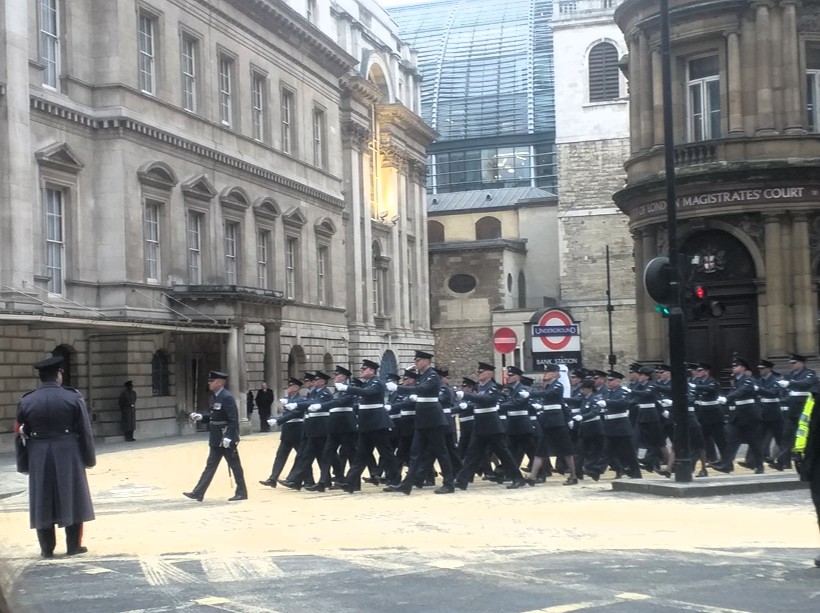
Cover picture: Walbrook on Lord Mayor’s Day 2019 (Philipp Röttgers)