by Dorothee Schröder
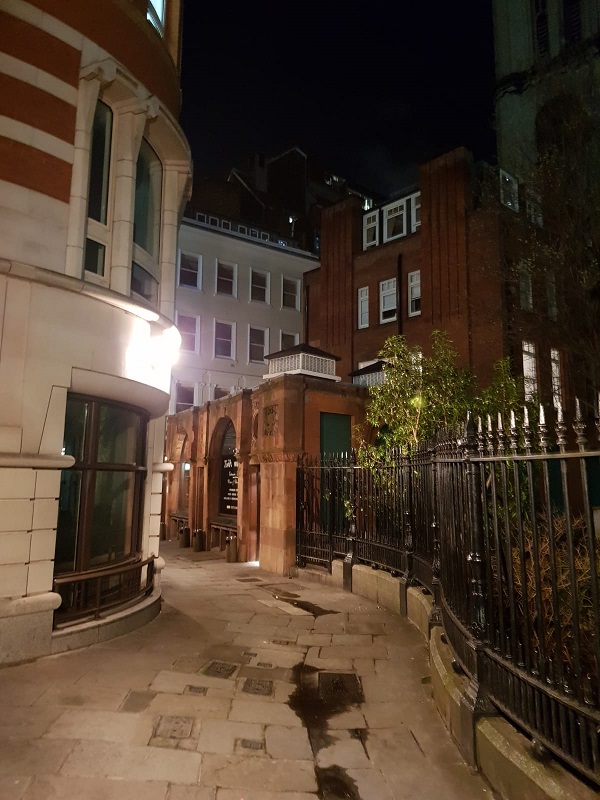
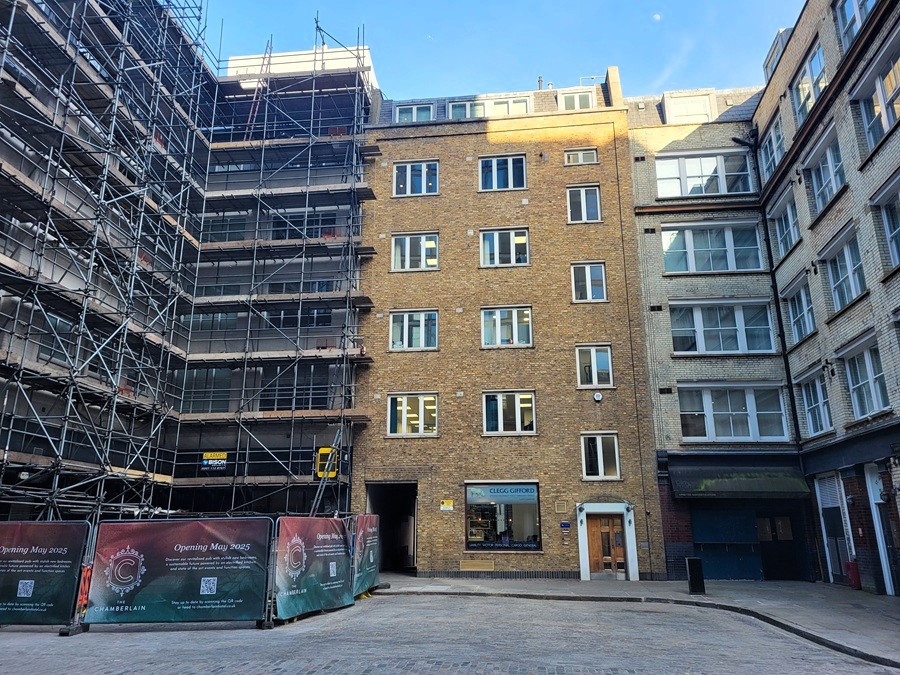
Vine Street is a small cul-de-sac in the City of London. It runs northwards from the junction of Crosswall and America Square and lies parallel to Minories. Easy to overlook, it is nevertheless deeply connected to ancient Roman London, as it is home to a remarkable display revealing a substantial section of the Roman city wall.
Londinium, Roman London, covered at least the area of today’s City of London and was surrounded by a defensive wall built around AD 200. This wall controlled access to the city via the Roman road network through a series of gates: Ludgate, Newgate, Cripplegate, Bishopsgate and Aldgate, listed clockwise from west to east. Around AD 350, Aldersgate was added between Newgate and Cripplegate. The final gate, Moorgate, was established much later, in the 15th century, as a postern gate. In addition to the gates, the wall was reinforced with towers and defensive ditches. It was constructed from Kentish ragstone, transported by barge from quarries near Maidstone.
Following the Roman departure from Britain around AD 410, the wall lost its purpose and gradually deteriorated. When the Anglo-Saxons regained control under Alfred the Great, redevelopment began after 886. The wall continued to define the boundaries of the City of London throughout the medieval period. Only in the 18th century, as the City expanded and traffic increased, was much of it demolished. After the Second World War, surviving sections of the wall were increasingly protected and designated as scheduled monuments.
One such section can be seen today at the City Wall at Vine Street, where a substantial stretch had long remained hidden in the basement of an office building, inaccessible to the public.
Vine Street also appears in literature. It is mentioned in Bradley Harper’s novel A Knife in the Fog, which imagines a young Arthur Conan Doyle becoming involved in the hunt for Jack the Ripper. Among his companions are Professor Joseph Bell, Doyle’s former surgery professor and the inspiration for Sherlock Holmes, and the author Margaret Harkness, who lives in Vine Street and knows how to use a Derringer.
So, Vine Street shows how even the smallest streets in the City can open unexpected windows onto London’s layered past — in history as well as in fiction.
Cover picture: Vine Street (Philipp Röttgers)