by Dorothee Schröder
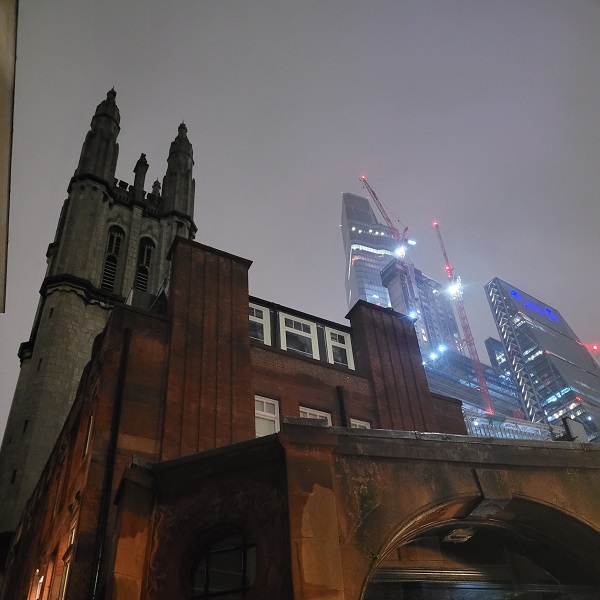
Seething Lane lies in the eastern part of the City of London. It runs from Hart Street in the north to Byward Street in the south, linking two notable churches: St Olave’s and All Hallows-by-the-Tower.
The street received its name in the medieval period, before the thirteenth century. It derives from the Old English sifeða, meaning bran, chaff, or siftings, a reminder that this was once no more than a narrow path where grain from the nearby corn market in Fenchurch Street was threshed.
In 1580, Sir Francis Walsingham, principal secretary to Queen Elizabeth I, moved into Seething Lane and lived here until his death ten years later.
A few decades on, in 1660, Samuel Pepys became Clerk of the Acts of the Navy. Since the Navy Office had been established in Seething Lane in 1656, he took up residence in a house between Seething Lane and Crutched Friars. It was here that he encountered Mrs Daniel, one of his many affairs, and where, after an amorous rendezvous, he bought eight pairs of gloves at a nearby milliner’s.
Pepys worked in the Navy Office for twelve years, eventually becoming Chief Secretary to the Admiralty. The building was destroyed by fire in 1673 and rebuilt over the following two years, the new structure designed by Sir Christopher Wren.
Long before that, in the fourteenth century, Sir Robert Knolles, also known as Knollys, an important English knight of the Hundred Years’ War, lived on the west side of Seething Lane with his wife Constance. While he was away travelling, she purchased the plot of land opposite their house, once used for threshing, and transformed it into a rose garden. She then had a footbridge built across the lane, linking her home to the garden. For this unauthorised construction she was given a curious punishment: the annual payment of one red rose on the feast of St John the Baptist.
The tradition survives today as the Knollys Rose Ceremony. Each June, the Company of Watermen and Lightermen processes from Seething Lane Gardens to the Mansion House, carrying a single red rose cut from the garden, to present it to the Lord Mayor of London.
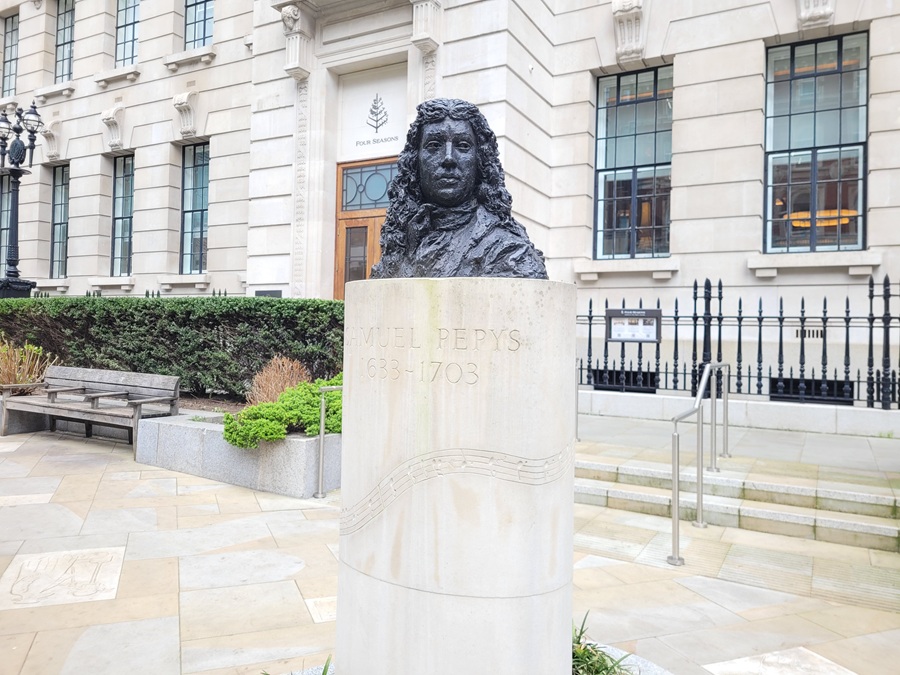
In Seething Lane Gardens, a bust commemorates Samuel Pepys, the diarist and statesman who is buried in St Olave’s Church at the north-western end of the street.
Although only a short lane, Seething Lane is steeped in history — and traces of its long past can still be found if you look closely.
Cover picture: Bust of Samuel Pepys in Seething Lane Gardens (Philipp Röttgers)