by Dorothee Schröder
A West End District in Camden
Bloomsbury is a district in London’s West End and forms part of the London Borough of Camden.
From Blemondisberi to Bloomsbury
The name Bloomsbury derives from Blemondisberi, first recorded in 1281. It refers to the Blemund family, one of whose members owned the manor in what was then a rural area outside the city.
A Centre of Learning and Culture
Bloomsbury is home to some of London’s most important cultural and educational institutions, including the British Museum, University College London, several institutes of the University of London, and the Royal Academy of Dramatic Art.
The Bloomsbury Group
The area is also renowned as an intellectual and literary centre. The Bloomsbury Group, which included figures such as Virginia Woolf, Lytton Strachey and John Maynard Keynes, met and lived here, shaping modern literature, art and thought.
Writers, Thinkers and Revolutionaries
Many famous individuals have lived in Bloomsbury, among them J. M. Barrie, Charles Darwin, Charles Dickens, Vladimir Lenin, Bob Marley, Dorothy L. Sayers and W. B. Yeats. Dickens’s former home in Doughty Street is now a museum where visitors can explore his life in the Victorian era.
Squares and Green Spaces
Bloomsbury is characterised by its green spaces and formal Georgian squares, including Russell Square, Bedford Square and Bloomsbury Square.
Great Ormond Street Hospital
Great Ormond Street Hospital for Children, located in Bloomsbury, is a world-leading centre for paediatric care. In 1929, J. M. Barrie, who lived nearby, donated the rights to Peter Pan to the hospital, allowing royalties to support its work to this day. Statues of Peter Pan and Tinker Bell stand outside the hospital.
A Shelter for London’s Cab Drivers
Russell Square is home to one of the thirteen surviving taxi drivers’ shelters, established by the Cabmen’s Shelter Fund. These small huts provided cab drivers with shelter, food and drink — a function they still serve today.
The Great Beer Flood
In 1814, the Horse Shoe Brewery off Dyott Street became the scene of the Great Beer Flood. When a large vat of porter burst, a wave of beer up to fifteen feet high swept through nearby streets, killing eight people.
Brutalism at the Brunswick Centre
The Brunswick Centre, located between Brunswick Square and Russell Square, is a mixed residential and shopping complex built in the late 1960s and early 1970s in Brutalist style. After a turbulent history, it was renovated in the early 2000s and now contains around 560 flats, shops, cafés, restaurants and a cinema. The Brunswick Centre has frequently been used as a filming location for cinema, television, music videos and advertising. Notable examples include Jack Nicholson’s The Passenger (1975), the Star Wars series Andor (2022), and Mansun’s music video Wide Open Space. The building has also inspired musicians, with the band Lodger dedicating a song to the centre.
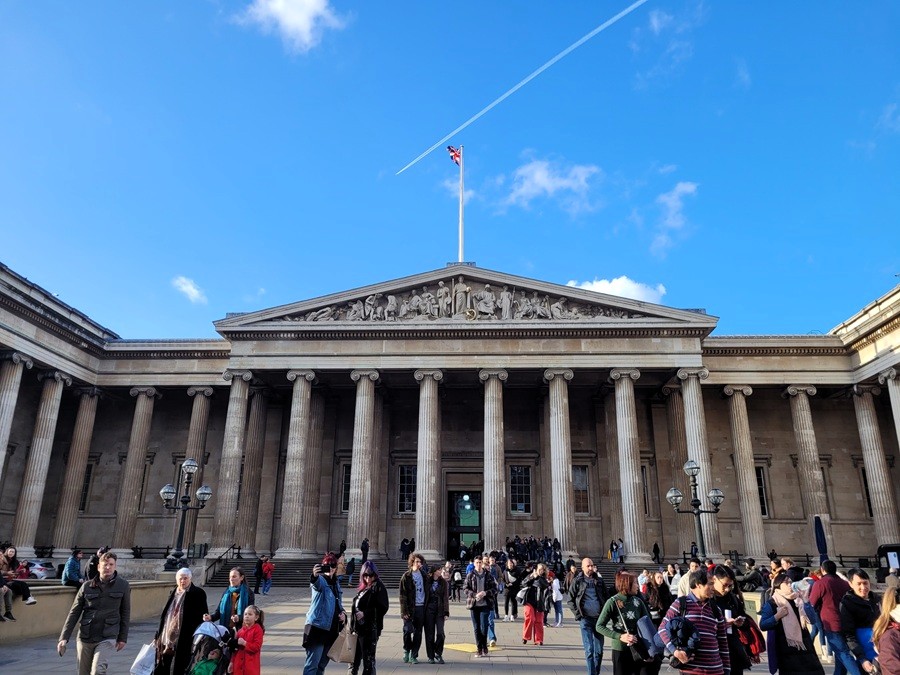
Cover picture: British Museum (Philipp Röttgers)