by Dorothee Schröder
It is impossible to speak of Upper Thames Street without also referring to Lower Thames Street, for the former is simply a continuation of the latter. Upper Thames Street runs north of the River Thames from the junction with Blackfriars Bridge in the west to the underpass of London Bridge in the east, where it becomes Lower Thames Street, which continues as far as Tower Hill. Together, the two streets form one of the City of London’s most important thoroughfares. Taken as a whole, Thames Street is the longest street in the City.
Built on the ground of the former Roman settlement of Londinium, the route is believed to follow the line of an ancient Roman road. On Lower Thames Street, the remains of a Roman bath were discovered and can still be seen, preserved in the cellar of the building now occupying the site.
Thanks to its proximity to the river, Thames Street played a crucial role in maritime trade. For centuries, port facilities, wharves and warehouses lined the street, linking the City directly to the Thames.
Just north of Upper Thames Street, on College Hill, stands St Michael Paternoster Royal, with its main façade facing the street. The church dates back to the thirteenth century, and in 1423 the legendary Lord Mayor Dick Whittington was buried in its churchyard, although the exact location of his grave has since been lost. The church was destroyed in the Great Fire of London and rebuilt under the direction of Sir Christopher Wren. Severely damaged again during the Blitz in the Second World War, it was restored between 1966 and 1968 and reopened on 19 December 1968 by the Duke of Edinburgh. At that time, it served as the headquarters of the Mission to Seamen — today known as the Mission to Seafarers — which supports chaplains working in ports around the world. In 2018, the office of the Bishop of London was also established there.
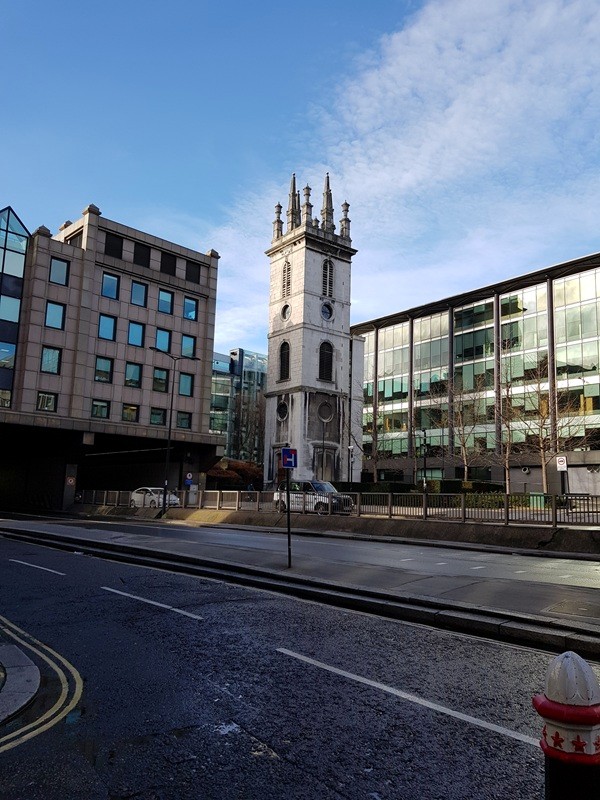
Another church once located on Upper Thames Street was St Mary Somerset. Founded in the twelfth century, it too fell victim to the Great Fire of 1666 and was rebuilt by Wren. In 1871, the body of the church was demolished, leaving only its tower, which still stands on Upper Thames Street today.
Upper Thames Street is also home to Dowgate Fire Station, the only fire station within the City of London and the base of the London Fire Brigade’s fire investigation unit.
Both Upper and Lower Thames Street have left their mark on literature. In Nicholas Nickleby, Charles Dickens sends Kate Nickleby to work along Thames Street. Arthur Conan Doyle sets scenes from his Sherlock Holmes stories in and around the area, while T. S. Eliot immortalised Thames Street in several lines of The Waste Land.
Today, the street remains a vital artery in a bustling modern city — yet traces of its long and layered past are still visible to those who take the time to look.
Cover picture: St Mary Somerset (Dorothee Schröder)