by Dorothee Schröder
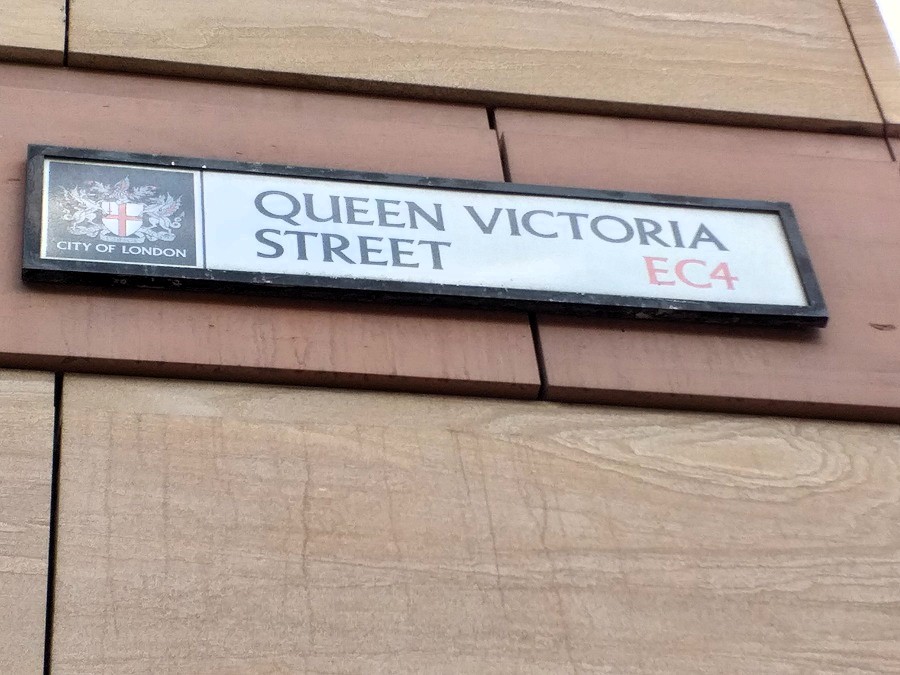
Queen Victoria Street takes its name from the monarch who reigned from 1837 to 1901. The street runs from the junction of New Bridge Street and Victoria Embankment in the west to the Bank junction in the east.
In 1861 it was decided that a broader street was needed to provide better access to the central business district. The cost of £1,000,000 was provided through the Metropolitan Improvement Act. Many streets, buildings, thoroughfares, and courts had to be demolished, and the area was completely reshaped.
The construction of the street proved challenging because of the steep gradients between Upper Thames Street and Cheapside. In some sections, existing streets had to be rerouted to create additional length over which the changes in elevation could be more evenly distributed.
Beneath Queen Victoria Street, gas and water pipelines were installed, along with house drains and sewers beneath them.
The street was formally opened in November 1871.
The Illustrated London News wrote:
“The ceremony of formally opening this new street, from Blackfriars Bridge to the Mansion House, was performed at half past three o’clock on Saturday afternoon. There was a procession of the officers and some members of the Metropolitan Board of Works and of the Corporation of the City headed by Colonel Hogg, Chairman of the Metropolitan Board, with the Lord Mayor, walking arm-in-arm, the Sheriffs of London and Middlesex, and several of the Parliamentary representatives of the metropolitan boroughs. These walked from Blackfriars, along the newly made roadway from New Earl-street to Bennet’s-hill, which has not hitherto been passable, and thence along the first-made portion of the new street to the Mansion House.
Having arrived at the hustings erected on the triangular space at the side of the Mansion House, Colonel Hogg and the Lord Mayor briefly addressed the persons there assembled, reminding them of the various City and Metropolitan improvements which had been accomplished during the last ten or fifteen years – the Thames Embankment, the Holborn Viaduct, the rebuilding of Blackfriars Bridge and Westminster Bridge, the opening of Southwark Bridge, the Metropolitan Meat Market, Southwark-street, Garrick-street, Burdett-street, Commercial-road, the removal of Middle-row Holborn, the opening of Hamilton-place, Park-lane, the laying out of Finsbury Park and Southwark Park.”
(11 November 1871)
During the Blitz, Queen Victoria Street suffered severe damage. When the area was rebuilt, a garden was created across three levels, each revealing traces of the site’s long history—from World War II bomb damage to medieval remains and even fragments of a Roman bathhouse. Today, it is a calm green oasis amid the busy city, complete with grapevines. The garden is named after Fred Cleary, known as “Flower Fred,” a chairman of the Metropolitan Public Gardens Association who established, maintained, and enhanced more than 150 green spaces in inner London.
So, although Queen Victoria Street is a major thoroughfare busy with traffic, it still offers a hidden spot where you can relax and experience London’s layered past.
Cover picture: Queen Victoria Street sign (Photographer: Philipp Röttgers)