by Dorothee Schröder
Rood Lane is a short lane in the eastern part of the City of London, lined today with huge and impressive office buildings. Yet as part of the former Roman settlement of Londinium, it carries a long and layered history shared, too, by the surrounding streets. For centuries, Rood Lane was especially known for the pattenmakers who lived and worked in and around the lane.
Pattens were wooden or metal undershoes strapped beneath one’s regular footwear, allowing people to walk above the mud and grime of the streets. They were used mainly by the upper classes, eager to protect their clothes and shoes from the filth that once covered London’s roads.
At the junction of Eastcheap and Rood Lane stands the Guild Church of St Margaret Pattens, designed and built by Sir Christopher Wren between 1684 and 1687. Its predecessor had fallen victim to the flames of the Great Fire of London in 1666. Yet the site has been sacred ground for far longer: a church dedicated to St Margaret of Antioch stood here for at least 900 years.
In the 15th century, the church became associated with the Worshipful Company of Pattenmakers, one of the City Livery Companies. Inside, you can still find a request for “women to leave their pattens before entering.” On the south wall, polished panels record the names of Past Masters, and the Company displays several historical pattens within the church.
In 1954, St Margaret Pattens became one of the City’s Guild churches after losing its status as a parish church. The Worshipful Company of Pattenmakers fitted it with new chandeliers in 2000 and contributed a stained-glass window showing the Company’s Arms. As the church is also home to the Worshipful Company of Basketmakers, both guilds arranged for the installation of a new winch system, and you can admire a display of woven baskets as well.
One of the bells recently restored at the Whitechapel Bell Foundry is particularly noteworthy, as it dates from before the Great Fire.
Adjacent to Fenchurch Street, Rood Lane reveals the rear side of 30 Fenchurch Street, one of the largest office buildings in the City. It stands on the remains of the former Roman settlement that Boudica burned in AD 60. A treasure trove of gold coins, probably dating from the 2nd century, was discovered on this very ground.
Here, too, it becomes clear how deeply the city’s past still rests just beneath the modern streets.
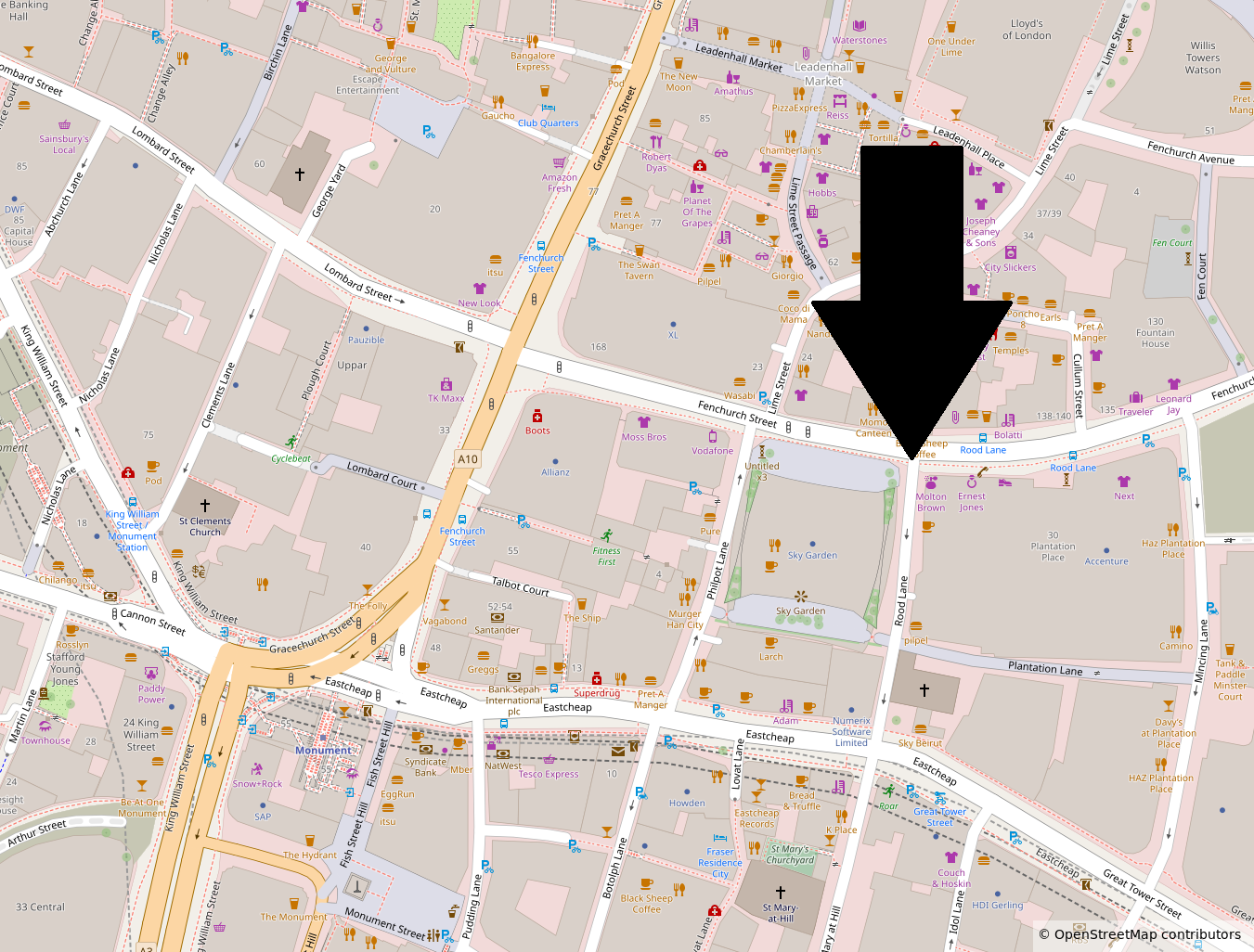
Cover picture: OpenStreetMap