by Dorothee Schröder
A Small but Densely Populated Borough
Islington, in north London, is the second smallest of the capital’s boroughs. It was created in 1965 through the merger of the former metropolitan boroughs of Islington and Finsbury.
The Origin of the Name
The name derives from the Old English Gislandune, meaning “Gisla’s Hill,” referring to the northern part of the area in Anglo-Saxon times.
From Middlesex to Greater London
Historically part of the county of Middlesex, Islington later fell under the Metropolitan Board of Works, which oversaw infrastructure across London. In 1889 it became part of the newly formed County of London.
A Historic Water Supply
For centuries, Islington’s hill supplied the City of London with water from springs in nearby Finsbury, until rising demand in the 17th century led to the construction of the New River, channelling fresh water from Hertfordshire to New River Head. For centuries, the hill on which Islington stands has played an important role in supplying the City of London with fresh water.
A Centre of Higher Education
Islington is home to City St George’s, University of London, as well as London Metropolitan University.
Upper Street
Upper Street forms the vibrant heart of Islington, lined with shops, pubs and restaurants, as well as notable churches and chapels.
The Royal Agricultural Hall
Built in 1862, the Royal Agricultural Hall was once London’s principal exhibition venue and one of the largest buildings of its kind, accommodating up to 50,000 people. Today its main hall forms part of the Business Design Centre.
The Regent’s Canal
Regent’s Canal cuts through Islington, disappearing into an 886-metre tunnel at Colebrook Row near Angel and re-emerging at Muriel Street close to Caledonian Road.
Islington in Literature
Islington has appeared in numerous works of literature, including Oliver Twist and David Copperfield by Charles Dickens, Neverwhere by Neil Gaiman, and Harry Potter and the Order of the Phoenix by J. K. Rowling.
Theatres and Culture
Islington offers a lively cultural scene, with venues such as the Almeida Theatre and the King’s Head Theatre.
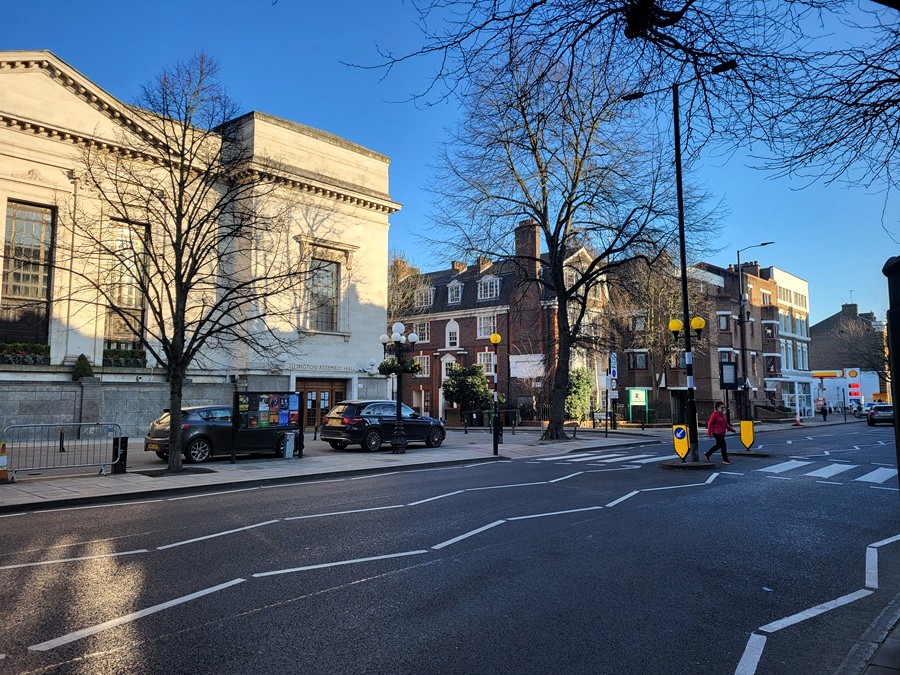
Cover picture: Upper Street (Photograph: Philipp Röttgers)